Turning a corner in Asheville
The Drive
It was a 10-hour drive from Chicago to Asheville. And another 10 back.
That’s long enough to second-guess the whole thing on the way down — and long enough to realize on the way back that something had changed.
We rolled in late Tuesday night and the first of the run was already underway. I had an uneasy mix of FOMO and low-grade anxiety that comes with arriving after something has already started.
We crashed at an Airbnb that was also housing a couple other Goats and overlooked a square that attracted a noisy group of late night revelers.
The next morning we got straight to work, setting up our studio space that would serve as home base for four days.
Asheville marked the first time I had cameras out. And I had a proper studio space — street-level, great light, right off a main drag, and just a couple blocks from the arena. Close enough that it felt connected to the scene, but controlled enough to actually sit down and talk.
We got in, set everything up, dialed the space. Between interviews, we’d blast Billy through the speakers so people walking by — or coming in — knew they were in the right place.
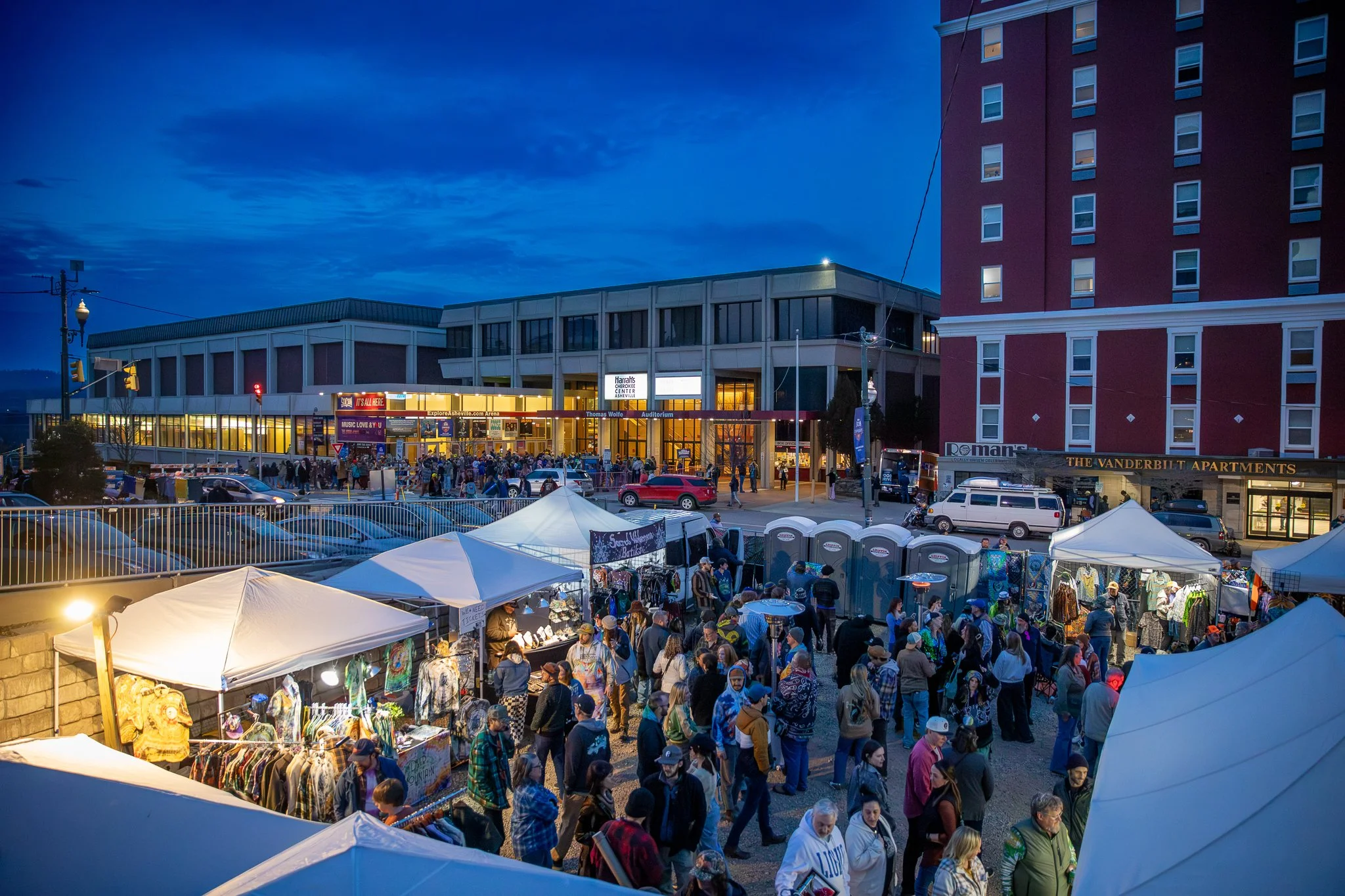
By early afternoon, we finally stepped out. Asheville wasn’t just hosting a run — it felt like it had been overtaken by it. We walked into one of a dozen Shakedown-style pop-ups at a distillery. And from there it just kept unfolding: Billy promotions, signs, people with instruments posted up on corners.
You didn’t have to go looking for it; it was everywhere you turned.
The arena and the main lot were the center of gravity — a full Shakedown setup directly across the street — but the energy spilled way beyond that. You could walk a few blocks in any direction and find another pocket of activity.
The Flow
Most mornings and early afternoons, we stayed in the studio. I had time scheduled with a few folk I knew would be in Asheville for the run, but left space for people on the fly. Again, the studio was essential — no noise, no chaos, just space to actually talk.
Then, late afternoon, we’d head out. Back to the lot and back into it: Talking to people, telling them what we were doing, handing out cards, pulling a few into quick on-the-spot conversations. A handful of those turned into scheduled interviews back at the studio later.
That flow — studio → lot → studio — became the rhythm of the week.
By the end of it, I came back with more than ten hours of interview content, across a range of voices that went beyond what I’d hoped for.
I’m hugely grateful for all the people who took the time to share their stories with me.
Meet Andy
I brought my buddy Andy down with me. When we left Chicago, he was just helping out, but by the end of the trip, it felt like something else — like the beginning of a real partnership.
This was his first real exposure to Billy. And you could see it happen in real time.
At first, it was just curiosity — hearing the music on the drive, being around it in the studio. Then we hit the lot. And that’s when it clicked.
But I still didn’t have tickets. I came down without them because I didn’t want to jinx anything. I felt that if the week went well, we’d have earned it.
And by Thursday night, I knew we were in and I bought us GA tickets for Friday.
Game on.
People kept asking Andy if it was his first show. And every time he said yes, they lit up. All day long, strangers were hyping him up, telling him what to expect, what to listen for, what moments to watch.
You’d think after all that buildup, there’s no way the show could deliver.
But if you know, you know.
The boys came out blazing with “The Fire on My Tongue,” and it was obvious.
Both of us just stood there, kind of stunned, as he went into “Bronzeback” and then “Red Rocking Chair.” I caught a couple I’d been chasing “The Cuckoo” and “The Train that Carried My Girl From Town” and the whole thing was transcendent.
By that point, we actually knew people — people we’d met, interviewed, spent time with throughout the week. We were running into them in the crowd, in the pit, on the floor.
And somewhere in there, I had this strange realization: For the first time, I felt like I wasn’t just observing this; I was inside it.
And at the exact same time, I knew I had a 10-hour drive home in less than 48 hours — and I was already thinking about how much I didn’t want to miss Saturday. That feeling… that’s new.
Saturday — Alone, But Locked In
Andy had to leave early Saturday morning — back to Chicago to keep building his own thing.
Which meant the entire final day was on me. And it was stacked: Back-to-back interviews from 10 a.m. to 6 p.m. No breaks, no reset. Just conversation after conversation after conversation.
It was exhausting, And also kind of perfect. Because by that point, the thing had momentum. People were showing up. The schedule was full. The work was happening.
At the end of the day, I packed everything down solo — a lot of gear, a lot of moving pieces — loaded up the car, and got ready to head out.
The Drive Home
The first real moment I had to process any of it was the drive back. Early start. Just me, ten hours through the Smokies.
And my brain just running.
I hadn’t had a second to step back all week. It was just go, go, go. But somewhere on that drive, it all started to settle in. What worked. What didn’t. Who I met. What this could become.
And more than anything: It felt like something had turned.
Like this wasn’t just an idea anymore. It had weight, it had shape, and it had momentum.
Milwaukee was the spark.
Louisville was the commitment.
Asheville was the turn.
Next stop: St. Augustine.
Louisville or bust!
Three months after Milwaukee — months of interviews, research, and immersion deep into the culture — I packed my gear and drove to Louisville. Same ritual. But I wasn’t the same person anymore.
Milwaukee was curiosity; Louisville was commitment.
The Bourbon Bar Shakedown — Where the Scene Reveals Itself
I barely had time to check into my hotel before heading to a Shakedown-style pop-up at a bourbon bar near the venue — a warm, crowded, creative microcosm of the Billy Strings universe. It was buzzing. Vendors lined the space, tables overflowing with art, patches, shirts, jewelry, and the unmistakable spirit of a traveling community that rebuilds itself city after city.
I talked with everyone I could — including one of the Train Songz artists, which felt like a perfect bit of narrative symmetry. I bought a shirt from him, and his work might be the single best example of how wildly cross-genre and inventive this scene is: a design inspired by Dopesmoker by Sleep, the legendary doom-metal album. Except here, the iconic cover art was reimagined with Billy and his band as the wandering figures, the text replaced with a heavy-metal-style “Strings.”
Bluegrass by way of stoner metal. A perfect collision of worlds. Only in this scene.
After a few hours of conversations, card-handing, and picking up gear, I jogged everything back to the hotel — because it was already time to jump in the GA line.
The GA Line — A Pilgrimage Within a Pilgrimage
One thing I’ve learned: the GA line is its own ecosystem. Part anticipation, part ritual, part storytelling circle.
While waiting, I met a father and son who had flown in from San Francisco — the son’s gift to his dad, an initiation into the phenomenon he’d fallen in love with. A first-timer and a seasoned traveler, standing side-by-side in the cold, both buzzing with the same excitement.
These are the moments where the why begins to reveal itself.
Inside the Pit — Immersed in the Hardcore
Once inside, I posted up just behind the rail — close enough to feel the electricity but not so close that I’d disrupt the world of the rail riders themselves. It’s a unique vantage point: half participant, half anthropologist.
I made fast friends with a truck driver who had driven in solo and had seen Billy more than 20 times. From the first three notes of every song he knew exactly what was coming. Watching him anticipate the set in real time felt like watching someone read prophecy.
Everything I’d studied about rail culture came to life:
the territorial intensity
the unspoken codes
the camaraderie and tension
the self-appointed mayors and gesture-leaders
the mix of transcendence and chaos
It’s the front-row sociology of a scene that both polices and celebrates itself.
The Show — A Dream Set, A Psychedelic Journey, and a Bill Monroe Revival
And then Billy came out, and the night took off. This ended up becoming my favorite Billy Strings show to date — a setlist that somehow managed to be psychedelic, precise, emotional, and historically reverent all at once. I’ve found it to be a familiar thing — one’s favorite Billy show is almost certainly the last.
Among my highlights were catching “All Fall Down,” “Away From the Mire,” and a ferocious, sprawling “Meet Me at the Creek” that stretched to nearly 15 minutes.
And then came a moment that felt almost supernatural:
Billy brought out Michael Cleveland, the legendary Kentucky fiddler, whose presence turned “Creek” into something mythic. Cleveland’s fiddle lines carved open the whole arena — a blast of old-time brilliance layered on top of Billy’s cosmic improvisation.
What struck me most wasn’t just the playing.
It was the crowd.
The entire arena would blast off into psychedelic ecstasy during the jams, and then absolutely erupt when Billy said he was going to play a Bill Monroe tune.
A foot in the future, a foot in the past.
A culture surfing two timelines at once.
After the Show — A Group Photo and a Daze
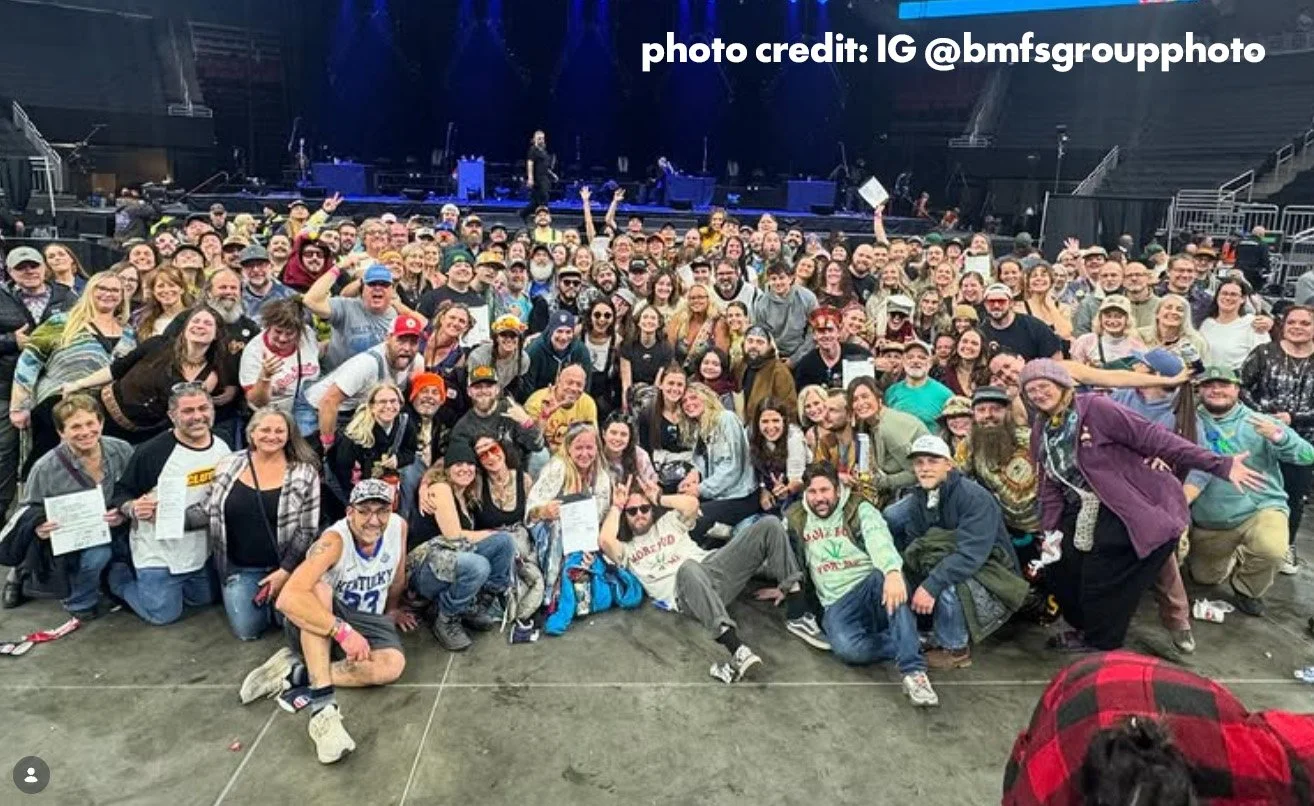
At the end of the night, a rail rider and superfan rounded everyone up for the traditional “end of show” group photo — a ritual I’d only seen online until then. I joined the group, smiling, dazed, drenched in adrenaline, suddenly aware of how deeply I’d drifted into this world.
Walking back to my hotel, I felt something shift.
This wasn’t just a great show.
This felt like confirmation.
The questions I came with had turned into a map.
The map had turned into a story.
And the story was beginning to tell itself.
I drove back to Chicago the next morning, tired and buzzing, more inspired
than ever.
Louisville as the End of Chapter One
Milwaukee was the spark.
The research, podcasts and projects like Train Songz was the compass.
Louisville was the moment the compass pointed toward a destination.
The project had shape now.
Themes were emerging, characters were sharpening, and the story was getting clearer, louder, more insistent.
Asheville on the Horizon
Next up: a full week in Asheville with cameras rolling, a studio build, and Clint as my local collaborator — the beginning of the film’s true production phase.
Louisville was the bookend of my initiation into this world.
Now comes the real work.
Paper trails
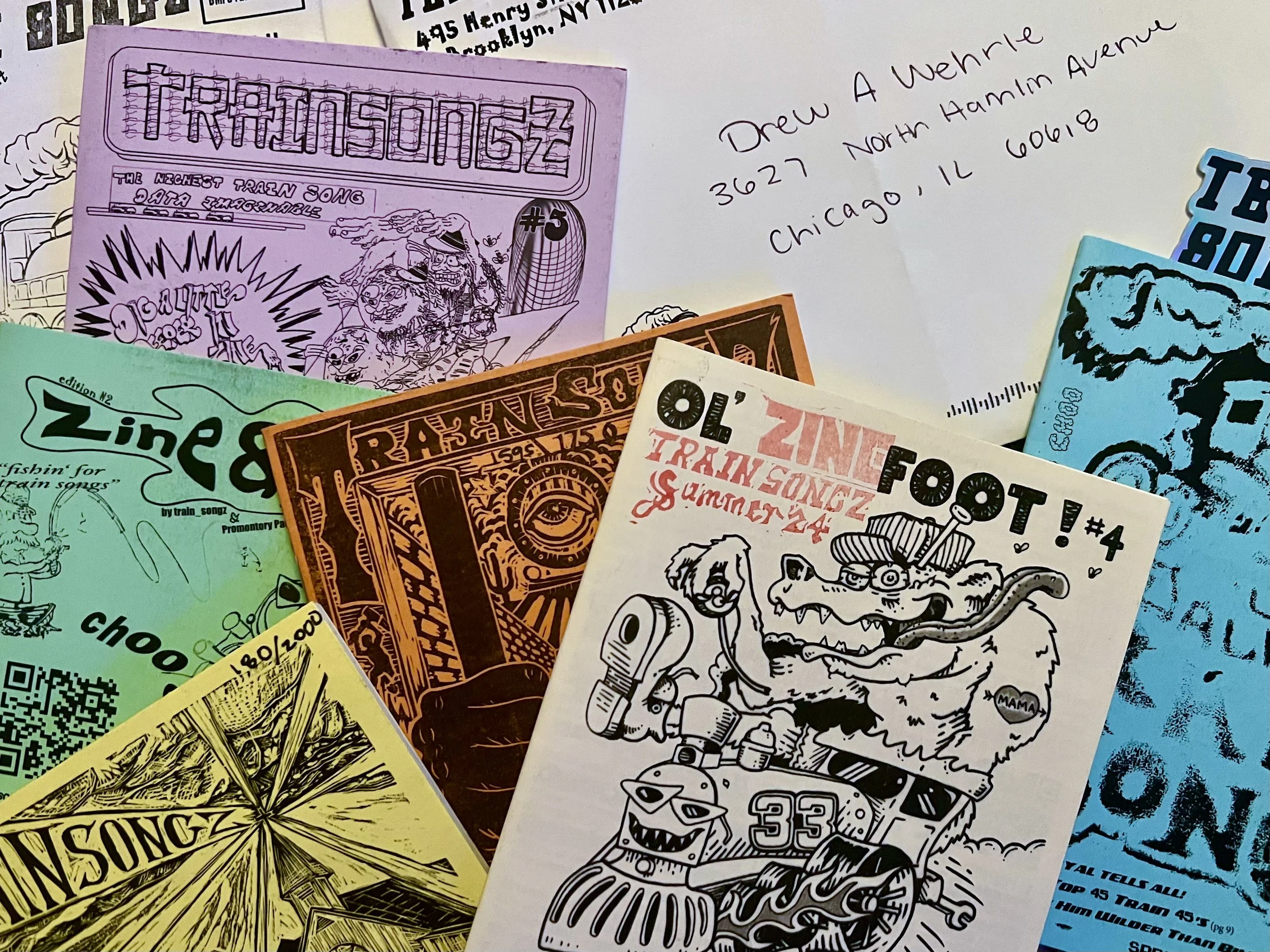
A few weeks after Milwaukee — after the Reddit wave, the interviews, the late-night research spirals — a white envelope showed up at my door. The return address was Brooklyn. Inside was a stack of zines: my first set of Train Songz back issues.
They weren’t slick. They weren’t algorithmic.They weren’t designed for virality. They were handmade. Physical. Thoughtful.
I came of age in the 90s, when zines were the lifeblood of indie culture. Punk zines, hardcore newsletters, Maximum Rocknroll — all proof a scene existed. In my early interviews, I heard it again and again — “you’ve got to check out Train Songz.”
It’s a handmade archive of a fan community refusing to exist solely online.
The zine launched for the fall and NYE 2023 run, and issues two and three quickly followed. This fall the eighth edition will hit the lots.
Train Songz traffics in the kind of content that has always made zines essential: fan essays, illustrations, inside jokes and reflections. Curious about the various lengths and styles of “Wild Bill Jones”? They’ve got you covered. Issue one set the tone, with detailed stats on the number of actual train songs that appeared in sets, along with insights like an audience can expect a train song 70 percent of the time when Billy is wearing a hat.
It reaches beyond Brooklyn, pulling in contributors from around the country.
It’s the scene documenting itself, in its own voice, with its own obsessions: railroads, setlist statistics, the vast universe of old-time music, and, naturally, songs about trains.
In a world where everything is content, Train Songz feels defiantly human.
Of course, for someone like me who’s scrambling to get up to speed, Train Songz offers a vital education — not just by unearthing the stories behind these age-old tunes, but also by documenting the scene in the real time. How much better is an enthusiastic review of the live debut of “Richard Petty” printed in ink? (Issue one!)
It’s fun to read the issues chronologically and watch the creative development and growth of the platform: new features, advertisers, charts, games, comics and contributors, more familiar deep dives on old time tunes. By issue 5, the masthead listes nearly 20 contributors.
In the time since I grabbed my first issue, it’s become clear that Train Songz is more than just a media entity — it’s a hub. You’ll find artists in their pages selling custom tees outside arenas; the Train Songz data comes through a partnership with the awesome BMFDB site, run by a couple of dedicated fans in Ohio; and Train Songz has even begun hosting shows along tentpole tour stops.
I have no doubt Train Songz will continue to evolve, but remain a core part of the BMFS universe.
Train Songz taught me a few things about the scene:
This scene is about myth-making: Train Songz articulates the railroad mythology that runs through Billy’s music and American roots culture.
This fandom cares deeply about preservation, which mirrors the archival instinct behind fan projects like BMFSDB and the broader culture of tapering and documentation.
Next, the scene contains multitudes — thinkers, writers, observers, data analysts, historians, jokesters.
Finally, Billy’s audience has more in common with punk and DIY ethos than people realize. There’s the same spirit of self-publishing, self-organizing, and self-understanding.
Beyond being an education, Train Songz reminded me that what I’m making shouldn’t feel sterile. It should feel lived in. Handheld. Messy. Alive.
Like a zine.
If Milwaukee showed me the size of this story, Train Songz gave me a glimpse into its soul.
Let’s do this
I didn’t expect a parking lot to change my life.
Let’s do this.
I didn’t expect a parking lot to change my life.
When I rolled into Milwaukee to see Billy Strings hit the Fiserv Forum on that Friday in August, I told myself I was just “getting a feel for things.”
I’d returned from a trip to San Francisco for the Dead 60 weekend with burning curiosity about the Billy Strings fan phenomenon. Half-formed, half-reckless and fueled by intuition, I printed a couple hundred business cards with a vague sense that if I put myself out there, something would happen.
Something happened. Many things happened.
What I stepped into wasn’t just a concert crowd. It was a universe — alive, organized, chaotic, generous, opinionated, spiritual, hilarious, and deeply human. And within 24 hours, this project went from hypothetical to inevitable.
Let’s back up.
So back in June I’d gone to my first Billy show, the second of a two-night run at Allstate Arena. When I stepped onto the lot, I could sense something totally different — a totally electric atmosphere.
We got to our seats and made friends with my neighbors, a young couple in from Pittsburgh. The woman literally screamed when she learned it would be my first show, and we talked about their fandom, the number of times they’d seen Billy, and other bluegrass artists they’d started following.
The band walked onstage and launched into the Stanley Brothers' "Robin Built a Nest on Daddy's Grave.” I couldn’t believe this song from the 1880s had kicked an arena-sized audience into an instant frenzy.
That first set delivered the eternal “John Henry,” the haunting “End of the Rainbow,” and two classics from the Doc Watson catalog. It was like a time machine. I spent the break back in conversation with my new Pittsburgh friends, peppering them with more questions about Billy’s repertoire, influences and backstory.
While I’m new to the unique bluegrass universe, I’m a longtime fan of the old weird America songbook: Harry Smith’s Anthology of American Folk Music, pre-war blues (especially the Piedmont variety) and much of the music that shares its ancestry. Hearing these interpreted like this was absolutely thrilling, and unlike anything I’d ever seen.
But when the boys returned, they turned the dial on that machine to the 1970s, dropping Black Sabbath and Led Zeppelin covers between originals, as well as a well-received “Tentacle Dragon” by Bela Fleck. My mind was blown anew, in a totally different way.
After the band left the stage and the lights came up, we lingered to watch credits roll on the big stage screen. The closing slate read “SEE YOU IN KC,” which I took as an invitation. My wife and kids were both asleep at home, but I considered this. What would it look like? It wasn’t that far, really.
My buddy and I walked out into lot, and the FOMO really kicked in. I looked over at a vendor making some late-night burritos — she’s be in KC. The kids blasting live Dead from a boombox out of a van almost certainly were going. That senior couple dressed in technicolor overalls? Of course.
Instead, I caught an Uber in the adjacent Target parking lot, a chaotic scene I’ve since learned isn’t a favorite spot among Goats.
But I couldn’t shake that buzz.
Less than two months later I was out in the Bay for the Dead 60 festivities. As we descended on Golden Gate Park, I couldn’t help but notice the massive delegation of Goats. It wasn’t only their number — they were visible. Sweatshirts and caps, but also colorful and custom fashion pieces with lyrics and symbols and signifiers from a complete universe. What was this?
At the end of that long, short weekend I returned to Chicago convinced there was something I needed to know more about. That next Friday Billy would be just ninety minutes north in Milwaukee. I didn’t have tickets, but I knew I needed to be there.
The Lot, the Cards, and the Awakening
I’ll be honest: handing out cards felt awkward at first. It’s one thing to conceptualize a documentary from the comfort of your desk; it’s another to walk up to strangers in a swirling Shakedown environment and say, “Hey, can I hear your story?”
But the moment I approached the first few people — rail riders, day trippers, families, super-fans — a door opened. People didn’t just talk; they wanted to tell me why they were here, what the music meant to them, what Billy represented in their lives.
There was no warming up. The conversations started at full intensity.
I made my way through the lot — vendors, jammers, healers. Not just tees and crystals, a full “Meet Me at the Creek” board game.
And everyone — everyone — had not only been out in SF, but had also been along for Billy’s three-show Australia run.
By the time doors opened, I knew I wasn’t in Milwaukee for one story — I was in there for a thousand.
The Moment I Realized I'm In Over My Head (In the Best Possible Way)
The show itself was a whole education: The communal energy; the musicianship that felt like a physical force; the pit culture, the rail culture, the awe, the chaos, the courtesy, the rowdiness. Ole Slew Foot.
I’d attended concerts my entire life, but this one felt different — a ritual, a communal surge, a bluegrass revival meeting with arena lighting and psychedelic transcendence.
The Reddit Post Hit — and Everything Changed
At set break I checked my phone. Someone had posted a photo of my card on Reddit. My inbox began filling with DMs and emails from fans as far away as Vietnam. I spent the next two weeks on Zoom, listening. By the end of September, I had spoken with quite a few folk — earnest, articulate, hilarious, skeptical, emotional. Each conversation peeled back another layer of the culture.
It became obvious: this isn’t a documentary about a popular musician — it’s a documentary about what people find when the music becomes the compass.
The First Wave of Interviews — A Cross-Section of America
I met people who treat Billy’s music like scripture.
People who say it saved their lives.
People who feel conflicted about the scene.
People who run archives out of spare bedrooms.
People just looking for connection.
And I realized: the Billy Strings phenomenon is actually 20 different stories happening at once.
The Moment the Project Became Real
At some point — after an interview with someone who described their first show as “a second chance at life” — I closed my laptop, stared at the wall, and said: “I guess I’m making a movie.”
The early days now feel like the overture — the rising theme before the story settles into its groove.
Let’s do this.